






Intro
Fun Boy Three, Squeeze, and the gang made new wave gems that made you both party and think. But today’s pop hits often borrow more than just vibes from the new wave era—sometimes it’s full melodies, riffs, or rhythms, smuggled into songs you’ve had on repeat. In this article, we connect five unexpected pairs: tracks that quietly echo the ’80s. Some are subtle nods. Others? Practically twins. Let’s dive in and uncover what’s hiding in plain sight.
"I stumbled on Fun Boy Three's Faith, Hope and Charity. The resemblance to SexyBack was uncanny:"
Justin Timberlake and Timbaland – SexyBack (Fun Boy Three – Faith, Hope and Charity)
Timbaland was in high demand by the mid-2000s, having already made twitchy, futuristic funk his signature. You can hear it in tracks like Missy Elliott’s Get Ur Freak On and Aaliyah’s Try Again.
In 2006, he produced Justin Timberlake’s FutureSex/LoveSounds, including the dominant single SexyBack. With its robotic call-and-response vocals, minimalist structure, and off-kilter funk groove, the track felt like a sharp turn for pop - but maybe not as sharp as it first appeared.
After getting into the Specials, I explored their offshoot group, Fun Boy Three - known for skeletal rhythms and deadpan vocals. A few years ago, while listening through some album cuts, I stumbled on Faith, Hope and Charity. It wasn’t a hit, but it stopped me in my tracks. The resemblance to SexyBack was uncanny:
- A monotone, call-and-response chorus
- Twitchy funk with a twist
- Sparse, robotic drum programming
The following year, Timbaland dove headfirst into new wave, producing three tracks (and contributing vocals) on Duran Duran's Red Carpet Massacre. In 2008, he’d work with Madonna too.
Intentional or not, it’s a reminder that new wave’s stranger corners - like Fun Boy Three - keep echoing into places you wouldn’t expect. Sometimes, even in a pop juggernaut.
Dua Lipa – Break My Heart (INXS – Need You Tonight)
The chorus to the British artist Dua Lipa’s Break My Heart feels like it’s been around forever with its urgency and funk. But she was already charting by the time it dropped. Her sound lands somewhere between P!nk’s confidence and Nelly Furtado’s sleek pop instincts, with a splash of Blondie's cool. Swagger: but with a modern twist. That makes her a fitting counterpart to INXS frontman Michael Hutchence—whose bluesy vocals and simmering charisma defined the band’s biggest hits. Both artists know how to make seduction sound like a power move.
Break My Heart has a straightforward message: Dua Lipa is falling hard for someone, but is afraid it won’t be returned or turn sour. The well-executed chorus is rapid-fire and catchy.
Australian new wavers INXS finally broke out with the album Kick by leaning more into bluesy guitars and vocals into their songs. The megahit Need You Tonight has such a guitar riff by Tim Farriss which is arguably the band’s best hook. It has urgent lyrics about lust.
Turns out Dua Lipa cleverly used Farriss’ rapid-fire guitar hook (giving INXS credit). But here’s the twist: it’s in the synth intro, instantly hooking the listener with a sure thing. And the chorus calls back to that in Dua Lipa’s vocals, not the easiest to do. It was a hook borrowed from a band with Hutchence’s male swagger, rather than being on the nose and invoking Blondie or Lauper. It’s a perfect example of a modern hit walking right in step with its new wave ancestors.
Shuki Levy – Heathcliff Theme (Squeeze – Cool for Cats)
A lot of ‘80s cartoon theme songs go big, and in 1984 Israeli musician Shuki Levy delivered one of the best examples: a song for the TV adaptation of Heathcliff.
Levy got his big break when teaming up with Haim Saban to compose a boatload of iconic cartoon theme songs, including Inspector Gadget. His themes often had new wave elements: synths, tight melodies and unexpected cool.
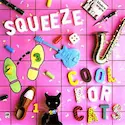
Earlier, Squeeze had their stylistic and commercial breakthrough in Cool for Cats. With its Cockney snarl, bouncing groove, and keyboard stabs, it helped define the band’s early sound. It also became a beloved track among new wave aficionados.
The Heathcliff theme has a brief but prominent Farfisa-like synth riff, a hallmark of early Squeeze. Could Levy have been a fan? It’s not hard to imagine him drawing inspiration from their sound. And while Cool for Cats is not about actual cats, Heathcliff’s definitely cool, with his smug and streetwise demeanor.
Musically, the connections are fun to spot:
- Both songs use a punchy, driving rhythm
- Both feature chant-like, non-verbal vocal sections (Heathcliff in the bridge, Cool for Cats in the outro)
- And that farfisa-esque synth riff in Heathcliff? It wouldn’t feel out of place on a Squeeze record.
Intentional or not, Levy may have slipped some of new wave’s cool detachment and swagger into Saturday morning TV. And when I see echoes of new wave rippling through unexpected places like Saturday morning cartoons, I get goosebumps.
⇩ Squeeze Song Commentaries Available in the Vault
Falco – Munich Girls (The Cars – Looking for Love)
The Cars’ album tracks were solid and underrated. Take Looking for Love - a mid-tempo groove with a safe melody and straightforward lyrics about casual sex. Think INXS without the danger. It’s a harmless, feel-good track.
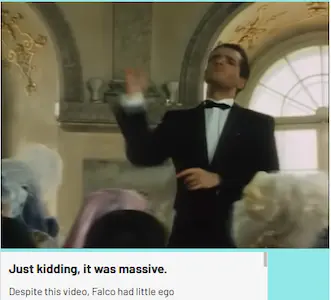
Two years later, Falco released the more accessible Falco 3. The smash Rock Me Amadeus resulted, along with Munich Girls. When I downloaded it in college Munich Girls wasn’t my favorite track, as it sounds like mainstream new wave. His signature rapping and quirks are all but gone. Also, I quickly realized that it shares the same melody, vocal cadences and (on the surface) theme with Looking For Love. He does add the Bavarian angle by changing the title to “Munich Girls”. I get it: Falco admires the Cars, and this is a competent echoing of Ocasek. Oh wait…
Falco says (translated from German) “Dollar or Deutschmark, never mind”, “come take the first bill”, “take the next bill”, and “take the very last bill”. Now I really got it! Ocasek and Falco are both charged with lust. But a key difference is that Ocasek makes reference to a “lover”, and Falco is with a prostitute. Falco found a way to give Looking for Love his signature dark twist! Two years later, Falco again showed his reverence to Ocasek by mimicking a vocal turn from Since You’re Gone in the first verse of Untouchable.
Alok, Sigala & Ellie Goulding – All By Myself (Depeche Mode – Enjoy the Silence)
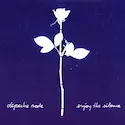
Brazilian EDM artist Alok doesn’t just sample Depeche Mode's Enjoy the Silence in All By Myself - it lifts its guitar riff wholesale. This riff is so iconic, with or without vocals. But Alok transforms that melancholic hook into a gleaming synth loop. Instead of layering around it, he lets it be the chorus. What was an emotional new wave hook becomes a festival-ready drop. Indeed, it was good for an American dance hit.
Alok made a good choice in enlisting Ellie Goulding for All By Myself, as this electro-pop is right in her wheelhouse. Goulding’s previous singles often featured her voice effectively floating over electronic textures and continues this in All By Myself. Indeed, she gives it just enough gravity to balance the drop-heavy production.
Lyrically its deeper than I initially gave it credit for: its about not succumbing to others’ negativity, and using affirmations to self-actualize. And I can’t help but notice it takes Martin Gore’s melancholy lyrics to Enjoy the Silence and turns it on its head. Granted, in both songs the singer gets the quiet and alone time they were looking for. But Enjoy the Silence is about retreat and emotional insulation - Martin Gore warns that “words are meaningless and forgettable.” Meanwhile, All By Myself flips that inward focus into resilience: alone time becomes a source of power, not protection.
⇩ Depeche Mode Song Commentaries Available in the Vault
Outro
From cartoon intros to EDM bangers, new wave isn’t just retro—it’s recycled, remixed, and reborn. Whether it’s a borrowed riff, a lifted groove, or an eerily similar melody, these echoes show just how deep the ’80s still run in modern music. If you spotted one here you’d never noticed before, let me know. And if you’ve got your own “wait a minute…” pairings, I’d love to hear them. Drop your discoveries in the comments.
Like this article? The Vault has bonus writeups on five articles.
A new one every month.
($8/month USD) Secure checkout with Gumroad